/ STORIES
Private Jet Charter in Europe: The Complete 2026 Guide

The short answer
Chartering a private jet in Europe in 2026 is a process with five core variables:
1: aircraft category (light, midsize, heavy, ultra-long-range, VIP airliner)
2:operator credentials (AOC, ARGUS/Wyvern rating)
3: departure airport (a business-aviation hub like Farnborough or Le Bourget moves faster than a commercial terminal)
4: tax and regulatory layer (the French ecotax on departures, EU's new ETIAS entry system, airport night curfews)
5: lead time (3–6 months for major event weekends; 2–3 weeks for off-peak summer).
Indicative one-way pricing ranges from EUR 7,500 for a light jet on a short European hop to EUR 110,000+ for an ultra-long-range to a Middle Eastern destination. Empty-leg flights typically discount 40–70% on the equivalent on-demand charter. The largest controllable cost driver is matching aircraft to mission, not negotiating the hourly rate. Everything below is the operational detail.
What are the benefits of flying on a private jet in Europe?
Three benefits are concrete and measurable; two are subjective and depend on the trip.
Schedule certainty. European commercial aviation in summer 2026 runs at or above 90% slot utilisation at Heathrow, Schiphol, Frankfurt, and Madrid. EU 261 statistics show roughly one in five short-haul flights delays beyond 15 minutes during peak summer. Private charter, departing from a business-aviation terminal, typically clears the airport in 8–15 minutes from arrival to wheels-up. On a 90-minute commercial-equivalent flight, the practical end-to-end time saving for one passenger is two to three hours.
Airport access. Commercial aircraft serve roughly 220 European airports; private charter serves more than 1,400. The practical effect: instead of London Heathrow → Nice Côte d'Azur → 50-minute road transfer to Saint-Tropez, the trip becomes London Biggin Hill → Saint-Tropez La Môle direct. Other examples include direct arrivals at Saint-Moritz, Samedan, Olbia Costa Smeralda, Calvi, and Verbier Sion, airports that no commercial wide-body schedule reaches.
Privacy. No commercial security queue, no manifest published on public flight trackers when filed appropriately, and on most aircraft, no other passengers. Privacy is also the variable most clients arrive expecting and most under-estimate the operational complexity of preserving. For VIP clients, the conversation typically extends to call-sign management, FBO drive-up access, and staff briefings.
Pets and special cargo. Pets travel in the cabin, not the hold. Larger animals can be accommodated. Special cargo (musical instruments, valuables, medical equipment) is handled inside the cabin without the routing required for commercial aviation.
The two subjective benefits.
First, productivity: a Wi-Fi-equipped midsize jet on a London → Ibiza routing is genuinely a workable office for one to four people.
Second, fatigue newer heavy and ultra-long-range jets (Gulfstream G650, Global 7500) maintain a cabin altitude of about 4,500 feet, which materially reduces fatigue on flights over six hours.
Where the case for charter is weakest. Single-passenger short hops between major commercial hubs as long as it's limited to 1 a day (London → Paris, Amsterdam → Frankfurt) where commercial business class is faster overall once you account for positioning. We tell clients honestly when a trip falls into this category.
How much does it cost to charter a private jet in Europe?
European charter pricing is the sum of six line items:
1. aircraft hourly rate
2. positioning (the cost of getting the aircraft to your departure airport)
3. crew accommodation and per-diem, landing/handling/parking/slot fees
4. catering and ground transport, and taxes (including the French ecotax on departures from French airports introduced in March 2025).
Indicative hourly rates:
Light jets (Phenom 300, Citation CJ4): EUR 3,500–5,500
Midsize jets (Citation XLS+, Praetor 600): EUR 5,500–7,500
Super-midsize (Challenger 350, Citation Longitude): EUR 7,500–10,500
Heavy jets (Falcon 900LX, Challenger 605): EUR 10,500–14,000
Ultra-long-range (Gulfstream G650, Global 7500): EUR 16,000–22,000
VIP airliners (A319, A320, 737 BBJ): EUR 22,000–30,000
Indicative one-way trip pricing from London Farnborough (EGLF):
To Nice: light jet from EUR 14,000; midsize from EUR 18,000; heavy from EUR 28,000
To Ibiza: light from EUR 15,000; midsize from EUR 19,000; heavy from EUR 30,000
To Olbia (Sardinia): midsize from EUR 22,000; heavy from EUR 34,000
To Mykonos: midsize from EUR 30,000; heavy from EUR 42,000
To New York: ultra-long-range from EUR 110,000
For a route-by-route, destination-by-destination price breakdown across 18 European destinations, see our Summer 2026 Europe by Private Jet guide.
The single most expensive mistake new charter clients make is over-aircraft. A family of four flying London → Ibiza for the weekend does not need a Gulfstream. A Phenom 300 is faster on that trip than a heavy and costs less than half. Mission-fit is the goal, not maximum cabin.
What types of private jets are available for charter in Europe?
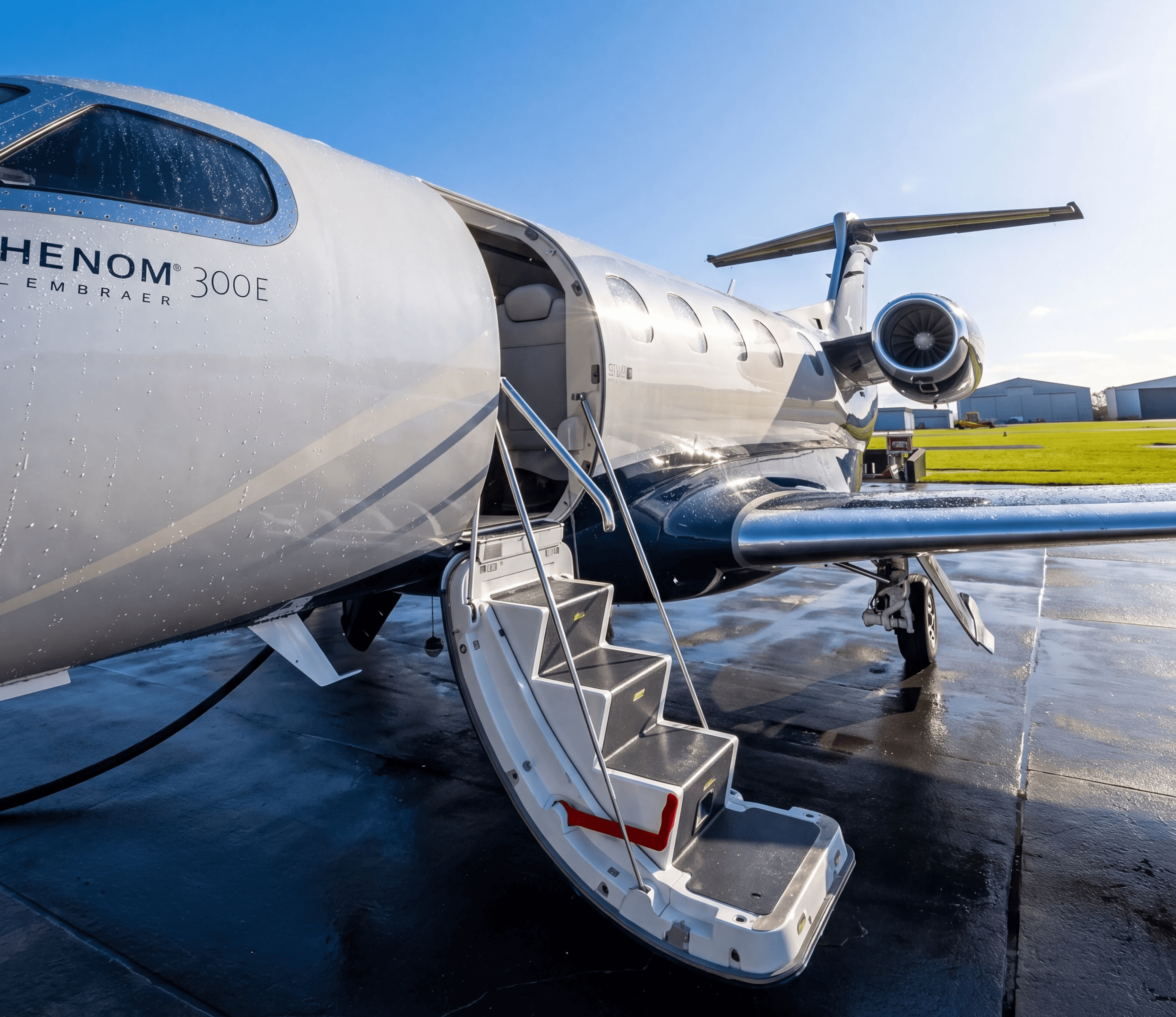
European charter inventory falls into five practical categories. Each is set by three constraints: runway available, range required, and headcount.
Light jets
Examples. Phenom 300, Citation CJ4, HondaJet Elite. Cabin. 4–7 passengers, baggage limited (typically 75 cubic feet of hold). Range. 1,300–1,800 nautical miles, 3–4 hours. Runway minimum. ~1,000 m. Capable of Saint-Tropez (LFTZ), Saint-Moritz (LSZS), Calvi (LFKC). Best for. European weekend hops, short Cycladic legs from Athens, business day-trips.
Midsize jets
Examples. Citation XLS+, Hawker 900XP, Praetor 600. Cabin. 7–9 passengers, full stand-up cabin, enclosed lavatory. Range. 2,500–3,500 nautical miles, 5–7 hours. Best for. The standard European intercity workhorse. London → Ibiza, Amsterdam → Olbia, Paris → Mykonos.
Super-midsize and heavy jets
Examples. Challenger 350 (super-mid), Falcon 900LX, Challenger 605, Gulfstream G450 (heavy). Cabin. 8–14 passengers, full stand-up, lie-flat options on heavy. Range. 3,000–5,000 nautical miles. Best for. Group travel to major events, longer Aegean and Eastern Mediterranean legs, families travelling with staff.
Ultra-long-range
Examples. Gulfstream G650/G700, Bombardier Global 7500. Cabin. 12–19 passengers, bedroom-configurable on G700/G7500. Range. 7,000–7,700 nautical miles. Best for. Inbound legs from the US East and West Coasts, Singapore and Hong Kong arrivals, multi-leg European-plus-onward itineraries.
VIP airliners
Examples. Airbus A319, A320, Boeing 737 BBJ in private configuration. Cabin. 16–48 passengers in full VIP layout, up to 80 in semi-VIP. Best for. Sports teams, large wedding parties, corporate group travel to major events (Dutch GP, British GP, large Wimbledon corporate groups).
What are the best private jet companies operating in Europe?
The question is more useful when reframed as: how do you evaluate a private jet company in Europe? The market is split between three categories.
Operators. Companies that own and crew the aircraft, holding an Air Operator's Certificate (AOC) issued by an EU member state's civil aviation authority. Major European operators include VistaJet, NetJets Europe, Flexjet, Luxaviation, TAG Aviation, GlobeAir (light jet specialist, Austria-based), Air Hamburg, GAMA Aviation, Comlux, and dozens of regional specialists. None of these is universally "best" — each has fleet strengths, regional base concentration, and a price-and-service positioning.
Brokers and operators-of-operators. Companies that arrange charters across the operator landscape but do not own aircraft. Major examples include Air Charter Service, PrivateFly (part of Directional Aviation), and many boutique brokerages, including OAŻI. The broker model is appropriate when you want operator-neutral selection — the best aircraft for the trip, not the best aircraft in one operator's fleet.
Membership programmes. Fractional ownership (NetJets, Flexjet) and jet cards (VistaJet's Programme membership, Sentient Jet, etc.) — you pre-pay for hours and access a guaranteed fleet on standard rates. Appropriate when you fly 75+ hours a year on similar routes.
How to evaluate any of them. Five hard signals to check before booking:
AOC. The aircraft must be operated under a valid AOC. Ask which authority issued it (e.g. EASA-member state).
Safety rating. ARGUS Gold or Platinum, Wyvern Wingman, or IS-BAO Stage 2/3. For US-registered tails, ARGUS or Wyvern is the standard. For European operators, IS-BAO is the international peer audit.
Insurance. Hull and passenger liability appropriate to the aircraft and route — typically USD 100 million minimum for European charter.
Crew experience. Captain hours on type, recency of recurrent training.
Fleet age and maintenance program. Newer aircraft from major OEMs on full manufacturer-recommended maintenance carry materially fewer mechanical cancellations.
OAŻI is a brokerage. We work across the operator landscape above, vet against the five signals on every quote, and disclose tail number on confirmation. We do not work with operators we don't 100% trust.
How do I book a private jet in Europe?
A first-time charter booking takes six steps. The first three are yours; the last three are the broker's job.
1. Define the trip. Route (departure and arrival airports, be specific about which London or Paris airport you want), dates (with flexibility windows if possible), passenger count, luggage volume, special cargo (musical instruments, sporting equipment, pets), special needs (mobility, dietary, medical). Send all of this in one go. A clear brief returns clean quotes in 60–90 minutes; a vague brief returns a back-and-forth.
2. Get quotes. Operators a lot of the time don't have the availability thats needed for your wishes. thats why you should work with one broker who will collect comparable quotes. The broker route is faster for clients because the broker normalises the line items into a single comparable structure.
3. Verify the operator. Before signing, confirm the AOC issuing authority, the safety rating (ARGUS, Wyvern, or IS-BAO), the specific tail number being offered, and the hull/liability insurance. Reputable brokers volunteer this information; if you have to ask twice, choose a different operator.
4. Review the contract. Standard terms include cancellation windows (typically EUR 0 cancellation up to 72 hours, then escalating), weather and mechanical-substitution provisions, and a deposit schedule (typically 50% at booking, balance at flight). Read the substitution clause carefully — if the contracted aircraft becomes unavailable, what is the operator obligated to provide?
5. Confirm and deposit. Standard payment is wire transfer; some operators accept card with a surcharge. The deposit is what locks the aircraft.
6. Pre-flight checklist. 24–48 hours before departure, confirm: passport validity (six months past return date for non-Schengen travel), ETIAS authorisation if relevant (see below), ground transport to and from the FBO, catering preferences, special-needs accommodations, and arrival time at the FBO (typically 30 minutes before departure for European trips, 60 for transatlantic).
The realistic timeline from first inquiry to wheels-up is 24–72 hours for off-peak summer travel and three to six months for major event weekends.
What is the process for customs and immigration when flying privately in Europe?
The process depends on whether your trip crosses an EU external border (e.g. UK → France) or stays within Schengen (e.g. France → Italy).
Within Schengen. No formal immigration check on arrival. The crew files a General Declaration (GenDec) with the destination airport's handling agent, listing passengers and crew. Most European business-aviation FBOs will request passport details in advance for compliance, but in practice arrival is an ID check at the FBO desk, completed in under five minutes.
EU external (UK to EU, US to EU, etc.). Customs and immigration meet you at the FBO. Most major European business-aviation airports — Farnborough (EGLF), Le Bourget (LFPB), Geneva (LSGG), Vienna (LOWW), Amsterdam Schiphol (EHAM), Luton (EGGW) — have dedicated FBO immigration channels. Typical processing is 10–20 minutes from aircraft door to vehicle, versus 45–90 minutes through a commercial terminal.
ETIAS — the change to plan for in 2026. The EU's European Travel Information and Authorisation System is rolling out for non-EU visa-exempt travellers (US, UK, Canadian, Australian passport holders, among many others) entering the Schengen Area. The authorisation is online, valid for three years, and required before boarding any aircraft entering Schengen. Confirm the rollout status for your nationality before booking — your operator or broker will flag it, but the responsibility for holding ETIAS sits with the passenger.
Passport pre-clearance. Most FBOs require passport scans 24–48 hours before departure. This is for GenDec filing and airport security pre-clearance, not for immigration approval.
Customs declaration. Standard EU duty-free allowances apply. For valuables (art, watches, jewellery) travelling for personal use, ATA Carnet or temporary import documentation should be considered for high-value items. Your broker should flag this if relevant.
Pets. Within the EU, the EU Pet Passport allows straightforward movement of dogs, cats, and ferrets with rabies vaccination, microchip, and a recent vet certificate. Entering the UK from the EU requires the Pet Travel Scheme — arrival at an approved port of entry; not every UK business-aviation airport is approved. Confirm at booking.
Are there any restrictions on flying private jets in Europe?
Yes: several, and the regulatory layer is changing more in 2025–2026 than it has in the previous decade. The honest answer is that most restrictions affect routing and timing rather than the ability to fly altogether.
Night curfews. Many major European airports restrict private movements at night. Indicative windows: London Heathrow 23:30–06:00 (effectively closed to charter), Frankfurt 23:00–05:00, Munich 22:00–06:00, Zurich 23:30–06:00, Amsterdam Schiphol restricted between 23:00–06:00 with strict slot limits. Workaround: most regional and dedicated business-aviation airports operate 24/7 (Farnborough, Le Bourget, Vienna).
Slot-restricted commercial hubs. Heathrow, Schiphol, Frankfurt, and Madrid Barajas operate slot allocation systems that make ad-hoc private movements very difficult during peak summer. Workaround: use the parallel business-aviation airport (Farnborough or Biggin Hill for London; Rotterdam for the Netherlands; Frankfurt-Hahn or Egelsbach for Frankfurt-area; Le Bourget for Paris).
Schiphol private movement cap (under proposal). Dutch government proposals to cap private movements at Schiphol have been in active discussion since 2024 and may take effect in 2026. The practical impact for OAŻI clients departing the Netherlands: Rotterdam The Hague (EHRD) and Eindhoven (EHEH) are the primary alternative business-aviation airports.
French ecotax. France introduced a per-passenger tax on private jet departures from French airports in March 2025, calibrated by aircraft category and route. The 2026 rate schedule is under review at the time of writing. The tax is added to the invoice; confirm current rates at quote stage.
EU 261 (passenger rights regulation). Applies to commercial aviation and to specific charter scenarios. The exact scope of EU 261 coverage for ad-hoc charter remains contested in case law. The practical takeaway: charter contracts include their own substitution, cancellation, and weather clauses, and these are what your remedies will be based on.
Sustainability mandates. SAF (Sustainable Aviation Fuel) blend mandates are rising across the EU under ReFuelEU Aviation, currently 2% blend in 2025, scaling to 6% by 2030. The cost pass-through to charter is small for now but will grow.
Russian airspace closure. Russian airspace remains closed to most European-registered private aircraft, affecting routing to East Asia and parts of the Middle East — typical re-routings via Caucasian or Central Asian corridors add 1.5–3 hours.
Aircraft age and noise. Some European airports restrict older aircraft on noise grounds (Stage 3 or below banned at many city airports; Stage 4 minimum at most). Modern aircraft (Stage 5 / Chapter 14) face no such restrictions.
What amenities can I expect on a private jet in Europe?
Amenities scale dramatically by aircraft category. The single biggest determinant of on-board experience is whether the aircraft has a galley with a flight attendant, which is typical from heavy jets up.
Catering. On light jets, expect a cold tray service: charcuterie, fruit, sandwiches, soft drinks, basic alcohol. On midsize jets, light hot service via a convection oven is possible, pre-warmed plated meals, espresso. On heavy jets and VIP airliners, full on-board catering with a flight attendant is standard, including à la carte service from notable European caterers (Air Culinaire Worldwide, Luxury Inflight Catering, Gate Gourmet's private division). Special diets are honoured if requested 24 hours ahead.
Wi-Fi. Variable. Newer heavy and ultra-long-range jets typically have Ka-band high-speed connectivity (Inmarsat Jet ConneX, ViaSat) — genuinely useful for video calls. Older heavies have Ku-band, slower but workable. Most light and midsize jets have either no Wi-Fi or Iridium-based connectivity (effective for messaging but not video). Always confirm at booking if connectivity matters.
Seating. Standard configurations include club-of-four (two pairs of seats facing each other), divans (sofa seating), and lie-flat seats on heavy and ultra-long-range jets. Genuine bedrooms exist only on G700 and Global 7500 class aircraft.
Lavatory. Enclosed lavatories from midsize jets up. Light jets typically have a curtained area with a chemical toilet, usable but not private in the way larger cabins are.
Cabin altitude. A meaningful differentiator on long flights. Newer ultra-long-range cabins (G650, G700, Global 7500) pressurise to about 4,500 feet at typical cruise, materially less fatigue on flights over six hours than older types that pressurise to 8,000 feet.
Smoking. Permitted on some operators' aircraft, prohibited on others. Confirm at booking. Most operators now prohibit, citing cleaning costs and crew preference.
Pets in cabin. Standard on private aircraft. Sized to fit the cabin; crew briefed in advance.
Children. No minimum age, no unaccompanied minor restrictions. Booster seats and infant restraints are typically available, confirm at booking.
Baggage. Light jets typically carry 60–80 cubic feet of hold; midsize 90–110; heavy 150+. For ski, dive, or golf trips, confirm capacity and any oversize-baggage handling at booking.
Privacy and entertainment. Most aircraft have personal screens; newer heavies have integrated cabin management systems controllable from your phone (lighting, temperature, blinds, audio).
How can I find empty leg flights for private jets in Europe?
Empty legs are repositioning flights an operator has to fly anyway, the aircraft is moving from one airport to another without passengers, and the operator wants to sell the seats at a discount rather than fly empty.
How discounts work. Typically 40–70% off the equivalent on-demand charter rate, occasionally deeper. The discount reflects the fact that you don't have control over routing or timing, you take what's on offer.
Where to find them.
Broker email and SMS lists. Most established brokers (including OAŻI) send empty-leg alerts to their client list. Sign up with two or three brokers whose route profiles match where you travel.
Operator-direct apps and websites. Major operators publish empty-leg inventory on their apps: VistaJet, PrivateFly, and others. NetJets fractional and Sentient Jet members receive curated empty-leg offers.
Empty-leg aggregator platforms. Several platforms aggregate empty-leg inventory across operators. The market has consolidated significantly in 2023–2025; the practical advice is to use one of the major established platforms rather than smaller specialists with limited inventory.
Last-minute jet-card and membership programmes. Membership in a jet-card programme (Sentient Jet, NetJets, VistaJet Programme) gives access to empty-leg offers before they hit public listings.
Honest reality of empty legs. Most empty legs are not "great deals" for most travellers because the routing is wrong for what you need — the aircraft is moving from where the last client left it to where the next client wants it. If your travel dates and route are flexible, empty legs are exceptional value. If they are fixed, you are usually better off paying full charter and getting exactly the trip you want.
Practical workflow.
Define your flexible window: which 7–10 day range works, and which 2–3 city pairs you'd accept.
Subscribe to broker alerts with that window.
Be ready to confirm in under 6 hours when a match appears, empty legs sell fast.
Confirm the operator and aircraft to the same standard as a full charter, empty-leg discounts do not change your safety and operator-credential checks.
For OAŻI clients, empty-leg matching is automated against the client's stated preferences and confirmed by a curator when the match passes our operator standards.
What are the most popular private jet destinations in Europe?
The summer 2026 ranking of European charter destinations, by booking volume from northern European departure airports, is:
French Riviera, Nice, Cannes, Saint-Tropez
Ibiza
Sardinia's Costa Smeralda (Olbia)
Mykonos
Mallorca
Monaco (via Nice + helicopter transfer)
The Amalfi Coast (Naples, Salerno)
Corfu
The Croatian Adriatic (Split, Dubrovnik)
Sicily (Catania, Palermo)
For each destination's primary airport, slot lead time, indicative pricing from London, Amsterdam, and Zurich, and the operational watch-outs (runway limits, ramp parking restrictions, ground transfer time), see our dedicated guide: Summer 2026 Europe by Private Jet: Destinations, Events & Airports. It covers 18 destinations and 20 major Summer 2026 events with full operational data.
For the wider European villa-stay context that often anchors these jet trips, see our Luxury Villa Rental in Europe guide.
Frequently asked questions
Do I need a passport to fly private within the EU?
You need photo ID for the General Declaration that the operator files with the destination airport. EU passports and national ID cards both work for intra-Schengen flights. For any flight crossing an EU external border, a passport is required.
How far in advance should I book?
Off-peak: 1–2 weeks is workable. Peak summer Mediterranean Saturdays: 3–4 weeks. Major event weekends (Monaco GP, Cannes Film Festival, Wimbledon finals, Dutch GP): 8–12 weeks. Sub-72-hour bookings are possible but priced against best-available, not best-fit.
Can I fly into Heathrow or Schiphol on a private jet?
Technically yes, in practice rarely. Both are slot-restricted commercial hubs where private movements compete with scheduled traffic. The practical answer is to use Farnborough (EGLF) or Biggin Hill (EGKB) for London and Rotterdam The Hague (EHRD) for the Netherlands — both are dedicated business-aviation airports with materially faster ground handling.
What's the difference between a broker and an operator?
An operator owns and crews the aircraft and holds the Air Operator's Certificate. A broker arranges charters across multiple operators on your behalf, with no fleet of its own. Brokers are appropriate when you want operator-neutral selection — the best aircraft for the specific trip rather than the best aircraft in one operator's fleet. OAŻI is a brokerage.
Is private jet charter safe?
Modern private aviation safety performance is excellent when the operator is properly credentialed. The single highest signal is the operator's AOC issuing authority (EASA-member state for European operations) combined with an independent safety rating — ARGUS Gold or Platinum, Wyvern Wingman, or IS-BAO Stage 2 or 3. Reputable brokers refuse to charter with operators below these thresholds. Ask which thresholds your broker uses.
Can I pay by card?
Most operators accept wire transfer as standard. Some accept card with a surcharge of 2–3%. Trip totals above EUR 30,000 are almost always wire-only.
What happens if my aircraft has a mechanical issue?
The operator's contract specifies the substitution remedy, typically an equivalent or upgraded aircraft from the same operator's fleet or a partner operator's fleet, at no extra cost. Review this clause before signing. Reputable operators maintain backup capacity for exactly this scenario.
Can I fly to or from a smaller regional airport?
Almost always, yes, that's a primary benefit of private charter. Europe has more than 1,400 charter-capable airports. The constraints are runway length (some smaller airports are light-jet-only), operating hours (some close at night), and FBO availability (some have only basic handling).
Do operators offer carbon offsetting?
Most major European operators offer optional carbon offsetting against verified standards (Gold Standard, Verified Carbon Standard). SAF (Sustainable Aviation Fuel) uplift is available at major business-aviation hubs — Farnborough, Geneva, Le Bourget, Zurich — and is the materially larger lever of the two for actual lifecycle impact reduction. Neither makes a flight "carbon neutral" in any rigorous sense.
What's the typical cancellation window?
A common structure: free cancellation up to 72 hours before departure, then graduated charges escalating to 100% within 24 hours. Operator-specific terms vary; some major operators use 7-day windows for major events. Read the cancellation clause before signing.
Plan your charter with OAŻI
OAŻI is an Amsterdam-based private travel boutique. We arrange on-demand private jet charters worldwide, alongside luxury villa stays across the Mediterranean and yacht charters from day boats to super yachts, with one curator handling movement and rest as a single continuous experience. The pricing ranges and operational notes in this guide reflect quotes placed in the last 90 days. Regulatory details (ETIAS rollout, French ecotax rate schedule, Schiphol movement cap proposals) are stated as of June 2026, confirm current status before any booking decision.
To plan a trip, contact OAŻI or call +31 6 8254 5110.